Showing posts with label antenna. Show all posts

Tuesday, May 7, 2013

New Android Devices 1:A Samsung Phone Clone


I decided to finally dip my toe into the Android world a few months ago with the purchase of a new Android phone. I should have done this over a year ago, at least, but I decided to give a Blackberry phone a try, first. Boy, what a disappointment and waste of time that was!

So I went looking at different phones and their prices. I was looking for something on the economy end of the scale at first, but as time went on and my BB convinced me I really needed to just pull the trigger as even a low-spec candy bar feature phone would be less frustrating, I upped my commitment to the point where I was looking at bigger displays.

To stay within the price range I was looking at (less than $200 at the end, though originally I had been thinking less that $100), I went looking at clone phones from China.

Not My First China Phone

Those of you who've been reading here a while may recall a series of articles about a prior phone I owned, a Sciphone G2. This was a Java-based feature phone that had been skinned to look like Android. It was an excellent phone, and it's use of Java was a big advantage for me, as there were plenty of good Java phone apps and I could write my own J2ME apps as well. Calling it a mere "feature phone" was an insult, in fact, as I'd rather have one of these than any of the contemporary iPhones that were out at the time.

In fact, after mine went to the eWaste recovery site in the sky, I wished I still had it every day that I was using my Blackberry 8900.

When I went to get another, new China phone, I returned to where I'd bought my G2, hoping to find something equally good. Unfortunately, when I returned to the BlueLans site, I found more clothing than electronics. Their phone selection was ridiculously out of date. Yes, at the time, with the BB 8900 on my belt, I really did consider buying another SciPhone G2.

So I went looking for another supplier. I tried getting a phone from PandaWill. But that turned into a fiasco. It never even got past customs. I ordered a phone from them with a version of Android on a 4" display for about $80. It would have been a good deal, if it had been for real. Unfortunately, they sent me some runaround about not being labelled properly to be shipped with the shipper I chose. They wanted to change shippers, and from what they were saying it didn't sound as if the phone was what it had been represented as on their web page, as well.

Round and round we went. After over a month past the promised delivery date, still no phone. Still some incomprehensible messages from them that made no sense. I tried to cancel the deal with them. They said the phone was in transit (though they also said it wasn't, and that they wanted to change shippers. How can they change shippers if it's in transit? I know there's a logical explanation, and I can think of several possibilities, but they refused to be clear in their communications.) Finally I demanded cancellation of the deal or I'd dispute with Paypal. That did the trick. Suddenly, all their excuses for why the deal couldn't be completed as they told me it could until I actually paid my money disappeared and they cancelled it.

Stay clear of them. If they're not entirely dishonest, they're at least shady enough you don't want to have to sort out a problem with them. If there's a problem of any sort, they'll make it your problem, and my experience they'll at least lie through omission to do so.

Attempt 2

For the second try, I decided to go through a supplier on Amazon with a good track record and Amazon fulfillment. That would at least give some shielding against what I'd just been through with the first place. Initially, I looked for the phone I'd tried to order before. But, it had been a bit longer, and I decided to go with something with a newer version of Android and a larger display (there had also been several more checks deposited to the bank since my first try. I guess that's one good thing about the delay.)

The phone I finally opted for was an SIII clone. It has a display just short of 5", and claimed to be running the Jelly Bean version of Android. Fortunately for me, I didn't care if the phone had Jelly Bean or Ice Cream Sandwich.

When the phone arrived, it was running 4.0, ICS. The About This Phone page had been programmed to lie and say 4.1 (Jelly Bean), but the interface was clearly not JB, the phone reported 4.0.x when I hooked it up to my PC with the Android development software, and the "Easter Egg" on the phone is the ICS easter egg, not the one for JB.

Nevertheless, it's a great phone. The display is really good, the responsiveness was good. It had the right amount of memory and the processor and all the other technical bits were as promised on the Amazon page.

In fact, it was good enough I bought two more. I got one for my daughter about a month after I bought mine. Hers came with a version of ICS with more of JB hacked into it. The interface was more JB, and it had the JB Easter Egg. I guess someone saw my post on Amazon and updated the things I specifically mentioned. It even reported that it was 4.1.x to my PC with the Android Development System. There were still some pieces of ICS in it, though. But it still ran great.

About two months later I bought another for my wife. This time the OS really was Jelly Bean. 100%. And it was a different phone, though the mold lines were about the same. My wife's phone has a much brighter an more vibrant display. That's the first thing I noticed. Inside, the layout of SIMs and memory card is different, as is the battery. And while I had to buy the back with the flip cover screen protector as an add-on for the phones for my wife and daughter, it came in the package with my wife's phone.

One thing to note--while I ordered the same model of phone for my wife, the original supplier I bought from for myself and my daughter had stopped listing that model of phone, so I went with another source. Another source, a different phone.

I'm not disappointed, though, on any count. Everything important about each of these phones was as I wanted it.


Review

Bottom line: This is a great phone. The actual phone interface in Android isn't everything I could want in the way of usability, but that's an Android problem (and each version varies.) Once you get used to the Android Phone application, they work well as a phone. The important functions for me, beside the usual calling and logging, are speaker phone ability and good reception in marginal areas. While my old, lamented Nokia 3650 was a better phone in both these respects, the SIII clone has been better than any phone I've owned since the 3650. It certainly beats out my "name brand" Blackberry, which was purchased in large part because it was lauded on these points.

Processor:
The MTK6577 processor is really what's in it, and it's a great processor for a phone. I would say my tablet blows it away, but my tablet needs to drive a whole lot more screen, so as far as my feeble human perception is concerned, they're both fast.

Memory:
It's a phone. There's never enough, especially when you're like me, loading oodles of memory hog techie apps like the Spartacus Rex Terminal Emulator. That said, it provides easy and immediate use of the MicroSD card memory when you put one in. Unlike, say, Samsung, which treats MicroSD as "something else". If an app allows itself to be loaded on the SD card, this phone will let you put it there and execute it from there. (For those not familiar with some other Android devices, they only use the SD card as data memory, and won't execute apps off of them, or move them to them.)

Programmers take note: making your app run off an SD card takes nothing more than a single line in your manifest file for the app, unless you're doing something on a very short list of things that require the app to be on the phone's main memory. (In which case, write a small helper app that does that in the phone's memory, then put the bulk of your app in another package on the SD card, dangit!)

Display:
It's great. My wife's phone is "wipe your chin, the drool is showing" beautiful, but the ones on my phone and my daughter's are very nice and sharp. Here's an oversized image. The colors are stronger and sharper than in this image, I did my best with the camera:


I/O:
USB works great for recharging as well as for mounting the phone as a file system to Linux, Windows 7 or XP, and Mac OS X. I haven't tried Win8, nor am I likely to unless I have a powerful incentive deposited to my account.

The Wifi is also excellent. I've had several devices with disappointing Wifi, some that cost many times what I paid for this phone. It hooks up easily, and gets good reception no matter what mishandling I'm engaged in with the phone while browsing or whatever. I depend on Wifi, as I'm way too darned cheap to pay for phone-based data services ever since T-Mobile screwed me out of my grandfathered plan after lying to me when I changed service plans.

Both SIM slots work fine, and like most clones, this phone functions fine without a SIM if you're not planning on using it with a phone service. It has two SIM slots, I use one, but plan to add a second SIM card since we have a county nearby where normal phone service from outside the county doesn't operate.

The phone does not include Near Field Communications or IR, but it does have Bluetooth. This works well with headsets and for data file transfers. It's easy to set up and connect to devices, and the antenna on this phone is good enough to get it a good range (I send photos to my computer when outside and around the house without a problem.)

Accessories:
I picked up the flip cover to keep the screen protector from being scratched. My phone came with the screen protector already on, as did my wife's phone, but my daughter had to put hers on. Since mine floats around in my pocket now, and I occasionally put metal things in there before I think to pull them out and move them to the other pocket, I decided to get the flip cover.

The flip cover comes as a new back for the phone. The new back has the cover attached.


At first I found the flip cover annoying whenever I had it open and in my hand. It can get in the way of your fingers, or press into them when you're gripping the phone. After a while, the area around the hinge of the flap gets softened, and this problem becomes pretty much unnoticeable. At first, however, it's a pain in the tookus.

Covers made for the Samsung SIII don't fit, there is enough difference in the forms of the two phones that even the soft "jelly" covers don't fit this phone. So don't plan to add anything specifically designed for the SIII if you get one of these.

Needless to say (I hope), you'll also want to add a MicroSD card to the phone. It's good for up to 32GB. I've got a 16GB in mine, loaded with books and apps, but with still about 9GB free. If I put much music on, that would probably fill it. Personally I recommend the smallest size you think you can live with, as larger cards tend to respond more slowly, especially if you have lots and lots of files in a single directory. This is aside from the concern about speed of the MicroSD. Get the fastest you can find, at least Class 6, if you don't want to hate your phone because you bought a slow MicroSD (I used mine with a Class 4 until I bought a Class 10 for it, and the difference when the new card went in was like someone opening the windows in a stuffy room.)

Wrap Up
Finally, if you don't have a phone with a recent Android OS (4.0 or newer), I highly recommend getting one. It's a solid OS with plenty of tools to let your smartphone be really smart rather than just a parasite living off your PC or a toy trapped inside other people's apps. Load up a real file manager (I recommend ES File Manager, for a start, but get several as each will have its own strengths), a terminal program (several will do the trick without "rooting" your phone), one of the Scripting Languages for Android (which work through SL4A) and a cool old system emulator or two. You'll have a phone that you can really compute on.

This phone is the best pocket-sized device I've had since my old HP 200LX. Believe me, I've blown over a couple of thousand trying to replace my old 200LX with other mobile devices, trying to get something that I could do with a mobile computer from 1994. Now I'm there.

In fact, things went so well for me with this phone, that I decided I'd pick up an Android tablet, too.

But that's another story.

Wednesday, April 3, 2013

Amateur Radio Desk Complete!

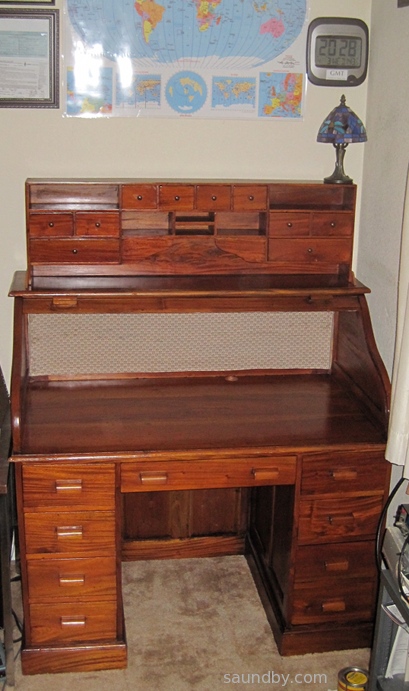
I've finished the rolltop desk that I started restoration work on this weekend.

Long story short, I needed a real place to put my amateur radio equipment. It's been perched on a short bookshelf behind my desk for months now. Before that it was in the living room on an end table beside my easy chair. Neither were great set-ups, of course. Now I've got a proper place for my radio station to stay, and I can protect it from dancing cats with the roll-down top. Here's the desk in its place:

Newly refinished roll top desk for amateur radio.

As you can see, I've already got some amateur radio paraphernalia on the walls around the desk. A world map formerly owned by KA6C (sk) passed on to me by George, KG6LSB along with a really cool collection of KA6C's QSL cards (which will be taking up residence in this desk.) The clock is not atomic, but it's set to within a minute of GMT so that I can keep track of world time properly. I have my old completion certificates, including one of my code completion certificates from the 70s, and my three licenses on the wall as well (KD6KGV, AG6HU, and my present call, W8BIT.)

Today the oil should be dry enough for me to start fitting out the desk with power strip and a mass of equipment, so it'll never look this nice again. Until I put the top down. That's the nice thing about a roll top desk.

I will probably have to wait until next week to route my antenna cables into the house through the crawlspace and up through the floor under the desk. I won't be able to get to it today, and we've got weather blowing in tomorrow and through the weekend. Fortunately the desk is next to the window where my temporary feedthrough brings the cables in, so I'll be able to operate until I get the cables re-routed through the new feedthrough.

Saturday, November 3, 2012

Ham Radio: A 2m Base Station Set Up

I posted some general information about my most recent work to get an amateur radio station up and running yesterday. Now I'll go into some specific detail on my 2m set up, which is up and running in a good enough state to get me through winter (I think.)

Interleaved Effort
The work I describe here happened in parallel with work on my HF station work. While I was up on the roof running antenna cables, I was running both sets of cables. While I was clearing shelf space for placing rigs and power supplies, I was clearing room for both. Fortunately it's worked out, even if it meant being a little less focused at times than I would have liked.

Building a Solid Station
Since I live in a gulch, with 100+ foot tall trees all around, getting a VHF signal from my house to anywhere is a challenge. While I managed to check into a net with a handie-talkie and a ground plane on a broomstick, this is not a plan for routine operation. I managed to check into a couple of nets with this configuration, but the signal reports were less than sterling, I had to chase around with the broomstick to try to find the best places for contact, which changed each time I tried. And having to go out into weather wasn't an appealing prospect.

To get a signal out of here, it was obvious I needed a few things. Like a rig with more power, a proper antenna, and, of course, a good low-loss feedline to tie them together. In other words, everything.

The Antenna
My initial thoughts were to mount the home-made ground plane on something better than a broomstick. But then further help came from a visit to the home of Bill, W6WEM, to have a look at his ground loop antenna (which I still hope to reproduce on my property, though it may wait till next spring.)

He had an unused pair of J-Pole antennas, one for 2m and the other for 440MHz. I don't have a rig for 440 yet, so it's laid aside (my daughter Amaryllis may have plans for it, we'll see.) But the 2m J-Pole I had immediate use for.

I scared up an extensible fiberglass pole that's about 10 feet long, and managed to attach it to a high eave on my garage good enough to stay through good weather. First, I connected to the J-Pole with an RG-58AU stub and an adaptor to go between the PL-259 on the antenna and the BNC on the cable. That went to a BNC to SMC adapter on my Handie-Talkie. I stood on the roof, with the HT just a little too high up to be comfortable, and managed to get into one of the two nearby repeaters I'd hit before with the broomstick groundplane.

With a new feedline, I would be able to raise the antenna higher, and who knows, maybe even talk from inside the house!

The Feedline
The 40m dipole I'd put up before hadn't gotten me any contacts yet. And it had my best piece of feedline for VHF, about 60 feet of RG-8 cable. I also had about 75 feet of some double-shielded 50 ohm cable, some Belden CATV cable on a par with the best RG-58. I could use the Belden cable on the 2m antenna, but its losses at 147MHz would be a lot higher than the RG-8. And the losses of the Belden would be not much more than the RG-8 at the lower frequencies that the 40m dipole would be used at.

So I decided to put the Belden cable on the 40m dipole, take off the RG-8 and put it on the 2m J-Pole.

I then used a collection of adaptors to get from the RG-8 to my HT without breaking the antenna connector (hopefully, though it may of weakened it, as it now needs repair, but I blame it getting caught under the car seat for the likely cause of the actual break.)

The Rig
Next was getting more watts. I bought a new rig, a Yaesu FT-2900R on sale at Ham Radio Outlet. It goes up to 75 watts. Almost certainly overkill, but then it would also have some value if I hooked up a beam and tried to get some DX over FM. Too bad it's not all mode. But that can happen later. Maybe I can even get somewhere with my old Kenwood TS-700A someday, with the other modes.

But for now, I decided to get the FT-2900R. I could have added PL to the old Kenwood and had 20W out, but it's receiver isn't very sensitive. By the time I've added PL and added hardware to compensate for the Kenwood's receiver, I'm within kissing range of the price of a new rig that just does the job for FM. So I went with the new rig. A new all-mode rig would have been nice, but wasn't available at the price of FM-only.

And the Rest
I managed to make out like a bandit at the SFARC annual white elephant sale (as well as getting some bucks into the club treasuring for the pleasure.) I got an MFJ-941C antenna tuner, a couple of nice power supplies (one still in the box), and some other fun bits.

Right now my HF rig and the FT-2900R are sharing a single power supply. The new one in the box is going to become my 2m rig's dedicated power supply.

I also have a place I've made in my in-home office, near my computers, that I've set the rig. I went up on the roof and moved the antenna cable to the other side of the house to meet up with the rig. I used the same feedthrough I made for the living room window in my office to bring it in, though the long-term plan is to bring it in through the crawlspace of the house.

All Together Now
Last week I went up on the roof and did something about the wobbly mount I had the J-Pole on. I put a proper antenna bracket pair on the house, and set the fiberglass pole, at full extension, into it. It's good for winter. The other setup lasted through a couple of windstorms, but frankly, I was surprised it did.

Last Thursday I got all the bits put together and checked out. I managed to check in that night to a regular 2m net for SFARC. Woohoo!

Everything is in a state that it can stay that way all winter, if need be. I'm planning some more minor changes to make things nicer, but it's all usable as is. Nothing is balanced precariously, or too fussy. I'm cleaning out a corner of the room to make space for a dedicated table for amateur radio now, and planning to reroute the antenna cable and put in a disconnect switch for lightning safety (I manually disconnect it when it's not in use, now.)

So I can say that for the first time I've got a real station set up. It's taken almost a year since I got my license to do so. But it's done.

Friday, February 3, 2012

Ongoing New Ham Progress: Antenna Work Today

Since obtaining my amateur radio license 73 days ago, I've made it a point to do something to get my station established every single day. Even on the days when I took a short get-away vacation with my wife, I took a little time each day to look at Craig's List for HF rigs, and on our last evening we went and bought a rig near where we were staying.

Some days it's been hanging dipoles and burying ground rods, other days it's been drawing QSL cards and applying for vanity call signs.

Today was one of the more active days, and it was a good day, too.

Pick and Choose

I've got several different projects going all at once. There's a lot to do. I'm still reorganizing the garage to make room for my planned shack location. I've got a dodgy short term 40m dipole up, a new 2m J Pole thanks to W6WEM, a nearly-done 10m loop, and prep work to do for a planned skywire loop for either 80 or 160m. Plus I'd like to order myself a new 2m rig and a 2m HT for my daughter, KJ6TFT--her birthday is this month.

Antenna Work

For today I decided to go with antennas. Exactly what was the next question. It's tough to pick if you have several possible directions you can go, each with different amounts of money and effort involved. Plus knowing that at the end of the work and money spent you may have ruined what did sorta work and replaced it with something new and expensive that doesn't work at all.

Ah, the joys of technical hobbies!

First I decided I should focus on what I had on hand rather than taking the time to leave the house and buy more parts. Feedlines was what I was thinking of buying today, from a local communications company. I figure I'll even pay them to put the connectors on for me.

But I've been dragging my feet on this. Without knowing where the antennas are going to be when I get them in a place where they work well, it's hard to know how long to make the feedlines. Too short creates an obvious problem--it won't reach from the antenna to the radio. Too long and I'm losing signal to line losses. Just to be clear, I'm not looking at ten or twenty feet too long, but at possibly 50 to 100 feet longer than may turn out to be required.

So...

I wanted to get the jpole up, so I can hopefully check into the local club nets without a broomstick in the driveway My feedlines on hand are a 70' length of RG-8, a 90' length of RG-58, and a 30' length of RG-58. While the RG-58 is fairly low loss foil shield type, a check with the MFJ-259B told me it's still going to lose about 2dB of signal over the length of the longer piece, which I'd need to get the jpole up where I want it, much more than the RG-8.

And the RG-8 was inconveniently located on my 40m dipole.

So I decided my first task would be bringing down the dipole. It's not easy making your first task taking something apart before getting something else working. I had to fight off the temptation to change gears to work on the 10m loop antenna.

I went up planning to drop the mast on my roof that supports one end of my 40m dipole. When I got there I saw that I could make the job easier by cutting the current mast into sections. Then later I could insert an extension to make it taller. In part, the height of the 40m antenna is limited by the RG-8 feedline's length. a feedline that's longer, and lighter, would allow me to raise the antenna. So I climbed down, got a different set of tools, and creatively cut the mast to bring it down without disturbing the original support.

Once down, I disconnected the RG-8 and decided to make some changes to the center of the dipole. Since it's still a temporary antenna, I didn't want to get too carried away, but I felt I could make some quick improvements that would pay off until I get either of the two loops up. I spent about half an hour on that, then returned to working on the jpole.

I fished out the fiberglass pole I'd originally used with my 2m ground plane (which got me nowhere until I put it on a broomstick). I checked to make sure it'd support the jpole well, adapted the jpole to the fiberglass pole so that it'd stay put and not come loose or move freely.

Then I took it up on the roof, and refurbished the fascia mount I'd used before. Fortunately I was able to get it to where it'd support the jpole and its mast safely, then took it down and added the feedline to the mix. The support was still sturdy with the weight and strain of the feedline, fortunately.

In the home stretch, I dithered about whether to add an "ugly balun" in the few extra feet of feedline. I've heard both ways for jpoles. Finally I decided to wind a choke in the feedline near the base of the mast, well below the bottom of the 'j'. So if the feedline's braid is forming part of the radiator, there's about 2.5m of it free to do so. But there's also an inline RF choke to limit RF coming back into the house.

Checking the New Antenna

I went inside and hooked up the MFJ-259B to the RG-8. The antenna looked good. Its SWR was good across the 2m band. Its resonant frequency is a little low for FM phone, it's near the top of the CW-RTTY section of the band. So I may see if I can retune it a bit before it goes to its eventual permanent location (more on that later.)

OK, I have antenna and feedline. Now, the rig! An HT...?

When I bought my HT, I thought to get an antenna adapter for it, too. The HT takes an SMA male connector on its antenna, I got an SMA to BNC adapter since I'd used BNC connectors on several of my 2m antennas in the 90s.

Now I put on the SMA to BNC adapter, then hooked up a BNC to SO-239 adapter. Then screwed the rig into the feedline. Well, a few feet of RG-8 are heavier and harder to move than a little HT, after all.

I tuned around a bit, and heard a conversation on a repeater in Vacaville, a bit over 80 miles away. Woohoo! I tuned to the frequency of W6EK, the repeater for the Sierra Foothills Amateur Radio Club and gave it a try, asking for a signal report. Nothing. No courtesy tone, no repeater waking up and identifying itself. I tried again, with the same result.

Then I moved over to the frequency for the Nevada County ARC repeater, W6DD and had another try. Success! I got back a reply of "5 but scratchy". I could at least keep checking in to that net without standing outside.

The scratchy bit concerned me, though. I was holding both the HT and the feedline because I didn't want to support the HT by the feedline but I also don't want to strain the HT's antenna connector with the stiff, heavy RG-8 cable. After listening for a while, I realized I was getting some dropouts on my end. The BNC connection wasn't as secure as it should be.

I tried another adapter and an old PL-259 to BNC cable with an SO-239 union in the line. It was even worse. So I filed that problem away mentally and went back outside to finish dealing with my HF antenna before the brief winter daylight was gone.

Restoring the "Old" Antenna

Half a dozen trips between roof and garage got the right tools and parts for a mast extension up there. As I worked, I was adding refinements. I decided to add a halyard arrangement to the mast. Before, it took bringing down the mast to get at the antenna. One eyebolt and a bit of rope now let me run it up and down with the mast in place.

The new mast came out about 8 feet taller than the old one. I'd sort of hoped for 12, but I didn't want to push its stability too far yet. I think I know what I need to do to get a 40-50 foot mast stable now using purpose-bought parts rather than whatever's in the shop. And the halyard is sweet. I had to rearrange the end support for the antenna to accommodate the changes, but thanks to the halyard the mast stayed up while I did it. And I erected the mast without the antenna pulling on it.

I also have a plan to raise the other end a bit, if I get back to it. But the antenna is laying much flatter than before. thanks to the higher mast, better adjustability with the halyard, and lighter feedline. I just had time to go inside and get a quick look with the antenna analyzer once it was back up. I had a dinner date with my wife tonight, with plans for a family game night once we returned home.

The antenna analyzer shows the reworked antenna at resonance at 7200kHz, with a 1.0 SWR. The SWR across the band peaks at 1.2. 15 meters looks better, too, and almost as good as 40. I went quickly through the spectrum, and I may be able to work in part of the 20m band with this antenna now, but the other bands didn't look promising. I'll take a better look tomorrow, and see if I can arrange a contact on 40m. I've had a few folks offer to help me out there.


Gaining Experience and Perspective

As I worked today I had an eye toward my future skywire installation. One of the tasks I laid aside today was walking around with a tape measure and a kid to plot the distances of trees on my property. I've been thinking in terms of a 160m loop, but today helped me see that I'm already halfway to an 80m loop. One leg of a square 80m loop is about 62 feet, not too far off from the length of my 40m dipole. Knowing that, I can eyeball the distances to two other possible supports.

So an 80m loop is what it'll be. No sense trying for a "bridge too far" when something good and not too difficult is right at hand. With an 80m loop, I can see not only the generalities of what I'd like to do, but also the details of what I actually can do to get it up and running. I'll probably do a "science experiment" on the upper part of the 40m dipole to make sure I know what I'm doing, but if I am, I could possibly have the loop up that day if I have the parts on hand. And part of the idea gets me a pair of 2m antennas (1 vertical, 1 horizontal) up where they may get a signal out to the south of me.

But more about that at a later date.

When my wife and I went to dinner we made a brief stop at W6WEM's house to take the pictures of his loop that I couldn't get on my first visit. It gave her a chance to see firsthand what sort of thing I'm planning to erect at our house. I think she was pleased by how subtle it was. I had to point it out to her, and she remarked "Oh, that's not bad at all!" with a pleased tone to her voice. I expect she'd already steeled herself to some sort of wire basket monstrosity weaving from tree to tree with dead condors caught in its arcing sections and lots of spiky bits to catch lightning and direct it at our house.

After dinner we made a brief stop at Radio Shack, where I may have found the solution to my bad 2m connection between tiny handheld and heavy hose feedline. Tomorrow will tell.

This is why I put so much effort into temporary stuff. The temporary stuff teaches me what I need to know to make good permanent stuff. And to have a realistic perspective on the resources and effort it'll take to build it, maintain it, and be effective with it. I've heard a lot of stories about stringing up some ad-hoc antenna and working DX the first night. I don't doubt them, but I always suspect there are far more stories about putting in a bunch of effort and getting nothing. Those stories aren't as much fun to tell.

I decided to talk about both my successes and my failures. Keeping astronomy observing logs since I was a kid taught me how much I learn from recording the nights where I go out and don't see a thing. But I learned. Now I hardly think about some of the lessons I've learned. Going out and seeing all, most of, or more than what I planned when observing is the norm now. But I had to learn some things along the way. Often through a bit of reality hitting me in the unrealistic hopes or poorly prepared plans.

I'm still learning a lot in amateur radio. Some of I have yet to learn is implied in what my fellow hams say to me that I've yet to learn to appreciate fully. Some is just incrementally working my way through the stages I'm in now.

I definitely have much more of an appreciation for what it takes to set up a solid station. And I'm also much more confident that I'm going to have something I can manage and keep on the air soon.

Thursday, February 2, 2012

Converging on a Plan for My HF Multiband Antenna

Presently I'm converging on figuring out what my "big" antenna is going to be. After visiting Bill, W6WEM and seeing his 80m loop I think a skywire loop is how I'm going to go. Bill uses 450 ohm ladder line and a transmatch on his antenna. The area the antenna covers is less than I'd anticipated, 80m isn't too much when divided four ways.

I'm still undecided about whether I'll make an 80m or 160m loop--that depends on measurements of possible support locations. I'm going to start out trying a coax feedline with a Q section as described by WA4HWN.

That saves me the cost of a balun to hook up the ladder line to my rig, for now at least. Eventually I'll probably end up with one of the manual tuners with a balun in it, but for now I'll plan to try the coax method for this antenna.

For supports, I have some trees but I think I've got an idea for adding some masts in the right locations if they become necessary to get a fairly round or square shape relative to a couple of trees that'll get one side up about 40-60 feet above the edge of a ridge at one side of my property. The antenna may end up sloping down a bit from that height, but less than the ground's slope and likely less than 20' of slope from one side to the other. Not quite as horizontal as could be, but adjusting just how high I put the supports on the high side could flatten things.

Any comments on my ideas are appreciated, this is the point where it's still cheap and easy to change plans. I'm particularly interested in comments on the feedline particulars and the height/slope of the antenna. Anything else is open for comment, too.

Tuesday, January 24, 2012

Amateur Radio: My First Net Check-In

Tonight I managed to successfully check into the 2m net for the Nevada County Amateur Radio Club. Originally I just intended to listen in and check in on the later 10m net. I figured I had a better chance of getting in to that, since VHF hasn't worked well for me previously.

So I tried to monitor the 2m net from inside next to my HF rig. First with my Yaesu FT-250R handie-talkie and its rubber duck antenna, then with my old Kenwood TS-700A and a ground plane antenna. The Kenwood's S-meter was seeing a signal, but I wasn't getting any audio.

So I disconnected the ground plane from the Kenwood, hunted up a short length of decent coax, and a broom handle. Yes, an actual broom handle. Or a mop, it's pretty universal.

Two large broccoli-bunch rubber bands later, I had the ground plane antenna mounted on the broom handle and with a nice little BNC adapter I had that hooked up to my Yaesu HT. Then I went out in the driveway and walked around.

Me with the amazing 2m broomstick antenna boom.
How I Did It. 40m dipole strung from tree to mast on roof, 2m Yagi 20' above garage roof, two Kenwood base stations. First net check in: 5W HT with a ground plane on a broom stick handheld in the driveway.

Now, I've tried to do this before to get in to the Grass Valley repeater, but it hasn't worked. In the past I had always looked for the strongest signal on the S-meter from the repeater while someone is talking. This time I figured I was just going to listen, so I went looking for the lowest noise level. I was getting the signal pretty well, with some cutting out here and there as I walked around. Once I found a spot with a pretty good signal, I'd walk around and see how much I could cut out the noise.

After a bit, as the check-ins went on, I had narrowed it down to two spots. I tried out each and decided it was pretty much even, so I stayed at the one closest to the house, figuring I'd be a bit less likely to kick a skunk where I had a bit of light. The HT and broomstick antenna was a two-handed affair, so there was no room left for a flashlight (besides, I was hoping there might be some aurora showing in the north tonight.)

I listened in on the check-ins, wondering why I was standing out in the dark and cold, wishing I'd worn the jacket with the gloves in the pocket as my hands got colder and number with each call sign that went by. I tried to help myself along by trying to figure out how long it might be until they got to the end of the list, but the list order appeared to be "the order they're written in", since there didn't seem to be the usual order by suffix or anything that I've heard used on the daytime 40m nets I've listened in on.

Checking In

Finally, the net control called for late check-ins and other club members. I decided to give it a try, someone else keyed up just as I was pressing PTT, so I let up and listened through their check-in. Another call for late club member check-ins, I gave it a try.

Net control couldn't make my call on the first go, but asked for me to repeat it with phonetics. I did so, he asked for a report on what I've been up to on HF, and I did that and turned it back over again. He got my call and my report and noted my check-in. I'd done it! Freezing in the dark with a wire ground plane on a broomstick and a 1.1 meter cable to my HT, with two adapters in the line (PL-259 to BNC, BNC to SMC.)

Now I've made my first contact outside the driveway, not counting a prior attempt to contact this repeater where they could hear me but couldn't copy.

10m Net: Good Thing I Didn't Wait

Once the 2m net was over, I went inside to see if I could check in on a second net on 10m. I had the HF rig already set up, but didn't hear anyone come on. After a while W6PD started calling CQ Grass Valley. I waited, after a bit he called CQ anyone and I tried to answer. He heard me calling, but couldn't pull me out of the noise even after I turned my power up all the way (100 watts.) I'm sure my 40m antenna, its orientation (Grass Valley is end-on, pretty much), its location and its poor parentage all contributed to the unsuccessful contact.

Which I why I'm hoping to get something else up soon. Nobody's answered my CQs on 40m, perhaps I'm not getting a signal out there to speak of, either. I might send my kid (KJ6TFT) out with my HT and my short wave radio, perhaps, and see if she can hear me then report back on 2m (I'll have the Kenwood here, which should be able to work FM simplex across town. Maybe.)

So, almost 2 months from license to first net check-in. With some wires on the end of a broomstick. :D

Wednesday, January 18, 2012

Received My First Radiogram Today

telegram boy drawingA short while ago I got a telephone call from a nearby radio amateur named Bill, call sign W6WEM, to tell me that he had a radiogram to deliver to me.

The message was from Pat, WB5NKD of Oklahoma City. I don't know Pat, but she sent me a nice message encouraging me to check out getting on the amateur radio nets and to learn to handle traffic. It's a standard message, and I appreciate getting it. Thanks, Pat!

As it happens, at the time the call came I was looking up various nets on the internet (you know, that thing that's like a radio net but it uses wires instead of radio waves. Apparently it's pretty well known these days.) Specifically, I was learning about a couple of nets called the Triple H net and the OMISS net, which both came up on a search for 40 meter nets. While I recognise these are not traffic nets, that is nets whose purpose is passing messages over the radio waves, I've also been looking in to and listening to those.

I have a 40m dipole antenna up right now, and daytime 40m radio comes in very nicely. During my mid-day breaks from classes I've been hearing some daily nets on 40m that are traffic nets. I've also listened in on some 2m nets, but since these are on repeaters I haven't been able to participate, as I don't have PL tones on my old 2m transceiver.

Bill, who delivered my radiogram, told me that he's on the California Traffic Net. They meet nightly on 80m, I'm planning on listening in on the first available evening and checking in if my antenna allows.

I talked to Bill a bit about what I'm up to here amateur-radio-wise, and asked about his station set up. He's got a skywire loop antenna, a type of antenna I've been thinking seriously about since I got some negative comments about my idea of possibly putting up a G5RV antenna at one of the local radio clubs. I'm planning to go by his place and have a look, and learn some of the details of putting up such an antenna myself. Bill's offered to give me a hand, apparently tree work was his business in the past, which is really neat since about all I know about trees is how to prune them or cut them down. ;)

Once I get a chance to learn a few things, I'll pull together the bits to put one of my own up. Bill commented that loops give a really low noise level, which I've learned to appreciate as a really good thing. 40m is fairly quiet on my current dipole at times, but at other times it's really noisy. And it's never really quiet.

Tonight I'm going to take a another look at what I've got for feedline, and at least know what I've got so that I can hopefully ask intelligent enough questions to figure out whether I can work with what I've got, or pick up some new feedline to go with the wire I buy for the skywire antenna.

Getting a Start in Amateur Radio--After the License
All this relates to the subject of what do you do to get going in amateur radio after passing the test. I've been trying to document a lot of what I've been doing, hopefully giving others some idea of what the process is like.

You pass the test, wait a few days to show up in the FCC's database. Then...

Then it's pretty easy to take a few basic steps. Get a VHF or UHF band handie-talkie or mobile rig and find the local repeater. I tried that, and have managed it when I leave the house. That seems easy, but it only gets you so far.

On my first go at amateur radio about 20 years ago I joined a local club and attended the meetings, but this didn't lead to as much in the way of contacts or learning how to operate as I hoped. In part it was because I didn't quite get the thing about nets. That there are different nets for different purposes, aside from the traffic-handling nets. Like the nets that help you make contacts in different areas for awards while you're learning the basics of operating on the air.

That first club also didn't have technical people like me. They were mostly focused on search and rescue, and did a great job of that. But when I had questions about antennas or projects to build gear, they weren't really in that part of the hobby and couldn't help me much. There was one fellow, Joe Sanches, AA6FT, who came occasionally and gave a great presentation on Amateur TV who was very encouraging to me. He urged me to get an Extra class license (I've done it now, Joe!), and seemed to be doing a lot of things that I was interested in. But I was distracted by being a new father at the time, having less money for hobbies all of a sudden (as a result of fatherhood), and just not making a lot of connections in the hobby in the time I did spend on it. After a while I felt like I was doing someone else's version of the hobby, not my own, and it sort of slipped to the wayside.

This time I'm trying to focus a bit more, learn some more, and get more involved so that it doesn't happen that way again.

I've joined two local clubs. While there's no club here in my own community, I happen to live about midway between two nearby communities with radio clubs. Between the two clubs I've attended three meetings since I got my license, and had a chance to meet quite a lot of local amateurs. I'm even starting to recognise some of them, and I'm trying to memorize some names and call signs. At one of the meetings, my daughter (KJ6TFT) and I got invited to a post-meeting get together at a local Denny's, which was really neat. It gave us both a chance to get to know some people better and learn some more about both amateur radio and the other folks' other interests.

One of the things I've noticed about hams is that when you catch them off the air, they often don't talk about their amateur radio stations or operations. You have to ask about it. I expect it's for a number of reasons. One being that hams are pretty much ordinary people in spite of their hobby (hihi), and it's not normal social discourse to walk up to someone and say things like "Hi, I'm WX6XYZ and I've got a Whammidyne 2300 putting out a kilowatt on a 123 foot inverted vee plus a 200 watt four bander in the pickup driving a screwdriver with a bug catcher. How about you?"

Another part of it is that once the station is established and operating more or less normally, there doesn't feel like much to say until something unusual happens like wind bringing down an antenna or a power surge blowing part of the radio.

So, if you're a new ham, here's my advice to you when talking to more established hams--be prepared to interview the other hams about their stuff if you want to learn about it. Ask if you can go to their place and see their station, antenna, or whatever and ask them detailed questions to draw them out. It's how I've started to learn.

Another factor that affects me is that I'm pretty darn technical. Probably more technical than the average ham, in fact. So when they get that sense, they may get the impression that I already know anything that they might tell me, or be sensitive about possibly telling me stuff I may already know. But when it comes to amateur radio, while I know all sorts of electronic theory and such, I'm really not very knowledgeable about anything else yet. And even where I know a lot of theory, I know very little about the practical realities. I'm not very experienced.

So while I can calculate the effects of using, say, 50 ohm feedline versus 75 ohm, I don't know the practical effects of how big a deal it really is, and whether there are some frequencies where it matters and others it doesn't. While a ham who's had a bit of experience, but doesn't know a Smith Chart from a travelling wave tube, knows more than I do about whether to just hook up the wire I've got and not sweat it, or whether to go down to the shop and buy a cable made of the right stuff.

At any rate, I'm persisting and learning. I've also got a little more money to put into things this time around and I'm not trying to be quite as hairshirt about it all, which is helping, too.

73 de W8BIT

Thursday, January 5, 2012

New Call Sign, New QSL Card

I'm afraid I didn't care much for the Extra class call sign I got from the sequential call sign assignment. It was AG6HU. Before it was assigned, I saw on AE7Q's site that I was likely to get a call from the range AG6HT through AG6HV. I would have been OK with HT or HV, but I was hoping I wouldn't get HU. The call sign is funky enough with the AG prefix, but with an HU suffix there's just nothing there to love.

I tried, I really did. I tried coming up with interesting phoney phonetics for it ("higher up", "hugely unpopular", "hic up", etc.) What really sealed that call's fate for me was when I tried telling it to people. It took a minimum of three tried to get it across, even when using the International Phonetic Alphabet. That's bad.

So I applied for a vanity call sign. I didn't rush right out, though I didn't dilly-dally, either. Knowing that I wasn't going to stick with AG6HU meant that I wanted to get a new call before establishing much of an identity with that call. I spent a lot of time thinking about what I'd want that'd still be fun to have 20 plus years from now.

Since retrocomputing and microcontrollers are both hobbies of mine, the call W8BIT seemed appropriate. That's what I put at the top of the list, and that's what I got. W6CPU and W6TTY were high on my list. I didn't realize it when I applied, but another ham applied for W6TTY a few days before I did, and got that assigned during the 18 day waiting period for my new call (not that it mattered, since my first choice was available, but an example of a good reason to have more than one choice and be prepared to not get your first choice.)

Another one that would have been a lot of fun is KO5MAC, since I'm a fan of the COSMAC microprocessor (the RCA 1802.) It's a bit more specialized than simply "8BIT", so it ended up as a lower preference. Beyond the first three choices I listed, I didn't worry much about the order of the other calls I put on the list relative to my preferences. Any of them were better than AG6HU, and I pretty well expected that things weren't very likely at all to go past the top three. KO5MAC would probably have been my fourth choice if I had arranged them. It's an awfully fun call sign, just like the 1802 is a really fun chip.

I considered having a call with my current favorite microcontroller referenced, the Atmel AVR, like, say K6AVR or W6AVR (no idea if these are in use or not.) But that seemed potentially even a bit more narrow than the COSMAC reference, especially when viewed from the perspective of 20 years from now.

I got my new call sign on the 4th, I'd already figured out what I wanted to do for my QSL card. I got 100 of them printed up today. Here's what it looks like:

QSL card for W8BIT, lots of 8-bit processors in the background, and one video chip that I mistook for a 6502 processor.


Ready to Go, Almost
On the more practical side of amateur radio--making actual radio contacts--I'm still moving things forward. Yesterday afternoon I replaced the towels stuffed in the window where the antenna cable comes through with a purpose-made wooden feedthrough. It looks a lot less "redneck" than the towels stuffed in a window casement.

Unfortunately, I don't have a good ground to the transceiver in its temporary home yet. I'd hoped to have time to pull that in yesterday but time ran short. But that's next. I'm not too worried about the ground when I'm just listening in, but before I key the mike I want to have a good ground on the radio's chassis. Then I'll be ready to jump into 40 meters, and possibly 15 meters.

I've been listening in a lot on 40 meters over the past week, and I'm starting to get a pretty good feel for the band. Like what frequencies folks are using pretty commonly, what sort of traffic is going on when (daily nets, some of the weekly nets, and so on.) So I'm pretty confident I won't seem to be a complete and total lid when I do key up. Though I'm prepared to make _some_ mistakes, it's part of the learning process.

Then the next major step is to clear out my corner of the garage, put in an AC/heater unit in the wall, a raised floor, and a bit of insulation. A few more touches like a mecca ground plate and feedthrough panel then I'm ready to put in shelves and furniture.

Somewhere in there I want to get or build a decent morse key or keyer. All I have on hand right now are a couple of ones of about the quality that were in kid's science kits 30-40 years ago.

So long as my current antenna keeps me going, I'll just go with it until the new radio shack is done before hanging up a new multiband antenna. A G5RV has been highly recommended to me by at least two hams. I've got a good idea of where a full size one would go on my property, and I'm looking to see if I can fit in a double-size one at right angles, more or less, to the first. That'd (hopefully) get me on the 160m band, too.

Lots to do, lots to do. In the meanwhile I'm going to grab my HT and make some contacts on 2m simplex.

73

Sunday, January 1, 2012

Got a Rig, Got an Antenna

I've got an HF rig for amateur radio now. I've been trying to figure out how to get started since working with the VHF equipment I already have on hand hasn't been working out well for me so far. Based on what I picked up on my short wave radio it looked like the high frequency bands should do well here where I live.

Last week I got a used Kenwood TS-450SAT. It's a really nice older rig, the set-up I bought included the antenna tuner (thus the "AT" in the model number) and a good power supply (Astron RS-35M). It's capable of 100W out on all the HF bands (less in AM, 40W if I recall correctly.)

Next I needed an antenna.

Two days ago I fashioned up a quickie dipole out of some 3/8" cable shielding I had on hand. It was the end of a spool, I had about 80 feet. I cut two pieces about 35 feet long to make a dipole about 67 feet long overall once all was said and done. My time was short, I soldered some 12 guage solid wire on to an SO-239 bulkhead connector, soldered that to ends of each piece of braid, put loops in the 12 guage and tied a piece of rope between them as strain relief, then make a couple of end insulators out of short chunks of PVC pipe.

More 12ga solid wire went into the outer ends of the PVC insulators to finish the antenna's first incarnation.

The light was already failing, but I managed to go outside and run the antenna from a manzanita bush on a hill next to my home, about 20 feet higher than my roof. The other end went to an old bicycle inner tube looped around one of the vents on my roof. A poor installation, but all I had time for as it was about full dark by the time I came back inside.

A sixty foot piece of RG-8 with PL-259s on the ends ran from the center connector, through a cracked window, to my rig. I stuffed the crack with ratty garage towels.

My MFJ-259B reported that the SWR was out of bounds on 160m, good on the high end of 80m, so-so across 40m, worse on 20 and 17m, good in 15m band, decent in 12m, and barely usable in 10m. What the heck. I hooked it up to the TS-450S.

I didn't know if I was going to try sending anything when I hooked it up, but once I got started I realized I had my hands full just figuring out how to listen on my new rig for the first evening. I managed to listen in on a net on 40 meters and hear a few QSOs. The antenna brought in more than I get with the whip on my short wave radio (whew!), but is still wasn't all that great.

I'd noticed that the MFJ-259B said that the best frequencies on my antenna were all just above or at the high end of the ham bands I most expected it to perform at.

So yesterday I went out with my ham daughter (KJ6TFT) and we did a re-do on the antenna. I shortened it up a bit (between stretching and poor quality control in the initial build it measured out as a bit over 68 feet), did some mechanical touch-up, and installed it in a better location.

I was limited by the length of my RG-8 feeder line, the only one to my name at present as another length of Belden duo-foil cable turned out to have a kink in it where the center conductor pushed through the inner insulation to touch the shield. So we ran around the steep end of my property with a 100' tape measure for a while and came up with an idea we hoped would work.

We picked an oak tree at about the right distance at the top of the property (still below the hilltop, which my neighbor owns) to attach a 12 foot board with one end of the antenna. The antenna then slopes down to another 12 foot board with a 2x3 reinforcing board that's attached to the edge of my garage roof and the garage wall through a T. We were planning to use nails at some points, but went to screws when it became apparent during the hand-held test-fit that tension was going to be a lot higher than we originally thought.

How is it that antennas weigh ten times as much in the air as when you carry them in your hands? ;)

We spent almost the full day working out the niggling details of this "temporary" antenna installation. Besides getting on the air quick, this antenna is also intended to give me some idea of what I can expect to catch off the air here, let me know how the orientation it's at will work (it's north-south), and otherwise just give me some practical experience before I start any elaborate plans for a permanent antenna.

I learned a lot before I even got to the point of hooking it back up to my rig. Which is good. I can see several mistakes I would have made if I'd tried to dive into a permanent antenna design right off the bat. I've heard it said that a quick and dirty antenna takes just as much work as a full-fledged proper job, so why bother with the quick and dirty at all? In my case I can say that by using available materials and not expecting too much I've managed to learn a lot that will make the "real" antenna a much better antenna than it would have been otherwise, and I'll have a much better idea of what to expect without making too many guesses.

Once hooked back up to the rig, the extra altitude of the new installation showed its effect. I was hearing a lot more across all bands. The difference was huge. When I later disconnected the cable and checked the antenna on the MFJ-259B the numbers looked only marginally better, but then an antenna analyzer doesn't evaluate the location of an antenna, except as it affects the antenna's electrical characteristics. At any rate, the SWR is better across most bands (some got just a little bit worse), but the real story is in the reception. Which is much improved.

So now I just need to do a little more reading in my transceiver's manual to make sure I have the least clue about what I'm doing when I hit the PTT button. So I'd better close out this post and get to it.

Wednesday, December 21, 2011

KJ6TFT's First QSO, My First QSL

My daughter's call sign showed up in the FCC ULS database today.

First QSO

I sent her out to the driveway with my 2M HT while I sat inside with my Kenwood TS-700A base station. I had a yagi up on the roof, in horizontal orientation so that I could try out SSB, but I figured at a distance of fifty feet or so orientation wouldn't matter much. I'd set the HT to the simplex frequency 147.510, and had been listening in on that frequency on the base station for a while to see if anyone else was using it.

The frequency was clear, my daughter was outside the house a way, I waved through the window to let her know to go ahead. She called me just fine, "AG6HU this is KJ6TFT." It came in clear on the Kenwood, I came back, "KJ6TFT, this is AG6HU. You're coming in five by nine."

"That's great! KJ6TFT."

"Do you want to give me a signal report?"

"Oh, yeah. You're loud and clear. KJ6TFT."

"Thanks. QSL?"

"What's that? KJ6TFT."

"It's confirmation of contact. Do you agree to confirm our contact?"

"Oh. I thought that was QSO. KJ6TFT."

"That's a communication. Like, Q Signal Out. It can be confusing. So, QSL?"

"Yeah, QSL. KJ6TFT."

"Great. Thanks. AG6HU clear."

"KJ6TFT clear."

You can read my daughter's account of her first contact here.

First QSL

After our communication I pulled up GIMP to make a special one-off QSL card for her. I printed it out on 110# cover stock and coated it with a clear fixative. That stiffened it up nicely. Here's my quick and dirty one-off QSL card:

AG6HU Radio to the World (or at least to the driveway.)


Afterward, I let her know that she didn't have to give her call sign on every transmission. I also had a quick look at the Kenwood. The antenna wasn't plugged in at all! Worrying about polarization is pretty meaningless when you're putting out RF from nothing more than an SO-239 plug. Still, we made the contact. But next time I think I'll at least stick a piece of hangar wire into the plug. ;)

Tuesday, December 20, 2011

She Passed the Amateur Radio Test

My oldest daughter, Amaryllis, went to take the Amateur Radio Exam this Saturday. I went along, for moral support and because I already knew the way to the exam site. Plus, she got to study while I drove.

She passed the Technician Class exam handily, and went on to take the General Class exam. She fell short of passing it by a few questions, but did well considering she hadn't studied beyond the Tech question pool and subjects. Maybe she'll want to upgrade this spring, I'm putting together an HF station to deal with the fact my house is in a gully surrounded by 100 foot tall VHF-eating trees. I suspect she'll want more HF privileges once she gets a taste of it.

She's blogged about her experiences here.

I took her up on the roof with me yesterday to put up a trial antenna for 2m SSB. I had her running the antenna analyzer while I made final adjustments to a four-element yagi on a fiberglass pole. She seemed to enjoy being part of the process and talking to me about how the antenna is supposed to work, what the numbers on the analyzer represent, and so on.

Antenna Hijinx

The yagi was a failure (terrain and trees win again), but our time together was good. The Kenwood TS-700A got one side of a nearby conversation on SSB, but it was down in the mud. The static was deafening. Next I'm going to see if turning the yagi to vertical will give me any improvements on FM over the three other antennas I've tried so far. Plus I'm going to see if I can't get a pilot line over a high tree branch with a bow and arrow (blunt tip) to pull up a 2m vertical and possibly a simple HF wire antenna to get started with once I've got an HF rig.

It'll go to the shortwave receiver until then to help me get a better idea of what I can catch here. The shortwave gets plenty of 80m at night, and picks up some 40 and 160m traffic, just with the built-in whip, indoors. It gets some 20m and 10m traffic, with hints of 15m, during the day. I think we're getting some beneficial knife-edge refraction off the surrounding terrain at 80m. I guess there's software to model this, it'd probably be worth my while to look into it before committing to a sizable antenna project.

As to 2m, at some point I'll get a more powerful rig--after I get the HF rig purchased. The Kenwood has no PL, but I'm going to try some FM simplex to see if that works better than SSB. If Amaryllis gets her call in a day or two I can send her out with my 2m HT and a car to see what sort of a pattern and signal strength we can get in and out of here from the nearby area. Plus, once school starts again I want to take a radio into class and do a little demo. Amaryllis can see what sort of signal we can get to the school (if any). Or I'll go if she'd rather run the Kenwood at home. We'll see.

Having a second ham in the house will sure be convenient.

Friday, December 16, 2011

Amateur Radio: A New Hope

After my prior post wondering what I should do to pull together a ham shack for <$1000 or so, I noticed I wasn't getting much feedback either online or off. This is usually a sign I've asked the wrong question. Sure enough, I've gotten a response now that verifies that.

Fortunately I've had a distraction that's kept me from fretting too much.

My oldest daughter has been studying for her own ham radio license.

The First Harmonic Doesn't Fall Far from the Primary

She's been playing with microcontrollers for the past several months, learning the basics of electronics and low level programming. When I talked about some of the things on the amateur radio exam, they sounded familiar to her. I guess I got her interested.

She's been studying for about a month now, in spite of distractions from work and her other hobbies. Tomorrow morning she's going to take the test. A week ago I wasn't sure she'd be ready, her online tests were coming up more fails than passes (the online tests are a really great study tool!) Since then, we've had mini lectures on propagation, capacitors and inductors, and rules & regs. She's also had a chance to focus on her study a lot more this week, and take more tests to see more of the questions. She's scoring much better now, consistently passing the test with 3-5 missed questions. Good enough to drive down to a test tomorrow morning.

Hopefully she'll have a CSCE tomorrow. If not, I'll tell her my stories of how I failed my first attempts at getting my license and reassure her that another test will be available soon. The only way to fail is to stop trying.

My Plan, Revised

To get an HF set-up of the sort I want takes more money than I have now. I started writing down lists of rigs, the necessary bits to get them on the air (power supplies, antenna tuners, etc.) and realized I can afford a single or dual band mobile, not a base station. Kits aren't all that cheap, either, once I look at what I can build without much infrastructure and get something of quality with long term value.

So, 1st step: be patient and build up money for a more realistic station budget--as I learn more.

Step 2: Try some more things to get some QSOs with my 2m FM HT on simplex (like from the parking lot at the store while the wife shops for XMas) plus see if I can get an SSB or CW signal out of my home location with the Kenwood TS-700A 2m rig I've got. Its receiver isn't very sensitive (I think the quartz stones in front of my house convert more signal), but we'll see. Maybe I can adjust that.

I'll also play around with horizontally polarized omnidirectional antennas or put up a beam and reposition it by hand every so often (no rotator yet--something else that'll take money when other things have been dealt with.) I put up a wire yagi last week, but couldn't hear an SSB net that was scheduled with the 700. Maybe I can figure out why this week.

Meanwhile, I'll see what I can log from parking lots with an HT. :)

2 meter band handheld transceiver

Tuesday, December 13, 2011

Best Starter Ham Shack for <$1000?

In my research I've stumbled on a question that elicits a lot of opinions. What's a good starter ham radio rig to buy? There are a lot of answers, and working through the answers requires a more specific question is what I've learned so far. So here goes. Short form first, more background below.

I'm looking for:

  • A fixed base rig to operate off wall power.

  • 80m to 10m, 160m is greatly desired, 6m would be a nice frill.

  • Rig price on the order of $500 or so, depending on extras:

  • With all the bits--filters, power supply, feedline, key and/or keyer, mike, antenna tuner, etc. I'd like to bring the bundle cost in at about $800, up to as much as $1000 once the last insulator, connector, and screw is in place.

  • Furniture and basic facilities like light, heat, and air isn't included in the cost,

  • but a lot of little things like the antenna feedthrough, cable, switches, and connectors are, which is why I'd like the big pieces to come in around $800.

  • I'd be willing to go higher if I felt really secure that I'm investing in something I'm likely to get much more or better use out of, but I'd still be capped about about $1200-1400 for now, anything more would have to wait.


Detail
My present home location appears to be best for HF work, so that's where I'm going to concentrate for now. I expect to pick up a good enough 2m rig to be able to hit the local repeaters for the sake of keeping in touch with the local hams, but VHF isn't where I'm looking to do my regular operating. This rig will be for a fixed station operated when the power is on, so portability and power conserving reception is not a factor, especially when weighed against receiver sensitivity and other such factors.

Antenna
I have plenty of space for an antenna, but I'm not expecting to start with anything sophisticated in the way of masts--trees will probably be my initial supports, or a small mast off the top of my garage. I have no fixed idea as to whether to build or buy my first HF antenna. I'd like it to be multiband. I'll look at ideas from stringing up a center-fed 12ga wire dipole to a quad band yagi with a rotator.

For the initial antenna set-up, I'm willing to compromise with the expectation of getting more or better later. But I want to start with something good enough that I'm not cut off at the knees while I'm still getting a feel for what I'm up to. It's worth noting that I have an MFJ-259B antenna analyzer on hand.

Operations
I don't know what my primary mode is going to be yet. I want to work CW and SSB. I'd like a rig that'll let me dabble a bit, so I'd prefer it to not have any major weaknesses even if it's, say, the greatest CW rig ever built. I'd like to try some digital modes, some SSTV, and some ATV.

The extra equipment for these other modes isn't included in the cost, I just want to be clear that I'd like a rig that can do it at least well enough to get started and figure out if I want to put more money into it later. So a rig that can handle the duty cycle these modes impose is probably going to be necessary.

QRP isn't where I'm looking to start here. I've already got my site working against me, and I really don't know what it's going to take in the way of power to work from here. So the rig should probably be about 100W or more until I know--unless you can tell me better.

I'm expecting to build my own QRP equipment later. The rig I'm looking at getting should be a solid workaday affair, I'll have fun building watch battery wonders later. ;)

QRU?
So, fellow hams, where does that put me? An old FT-450 or TS-480? Or one of the new "shack in a box" rigs with some extras? Would I be better off springing for a good beam and rotator now, or will a wire dipole hung from some spruce trees get me enough QSOs to keep me going until the money reserves and operating experience build up?

Your opinions are welcome. I know that you can't tell me exactly what I should get. I'm just looking for opinions more seasoned than my own wild guesses. I just want to get an idea to start out reasonably effectively, while keeping the spending down enough that it won't ruin the hobby even if nothing I do works out as planned. ;)

Saturday, December 10, 2011

New Ham Progress: Working Toward a Working Station

It's been 3 weeks since I got my CSCE for my amateur radio license, two and a half weeks since my license appeared in the FCC database. Each day I've been working to make material progress to set up a station and start operating. So far I'm not fully "on the air", though I've made a lot of progress.

my certificate of successful completion of exam for all three amateur radio tests
I passed the tests! Now what?

Getting a station up and running could happen quickly through purchasing a "shack in a box" transceiver with antenna, feedline, and accessories and setting them up. The set-up of the antenna, feedline feed-through, and learning to operate the transceiver and the aavailable ba would be no small feat in and of itself. But I'm taking a bit slower path.

As I progress, I'm learning a bit more about what I've got to work with--hopefully leading to better decisions when it does come time to lay out for equipment.

Starting Point
While I had a ham license before, I did very little with it. I had a mobile 2m rig in my car that I used on the local repeater. I helped at a local long-disstance charity run. I hoped for more, but that's all I did. I never really built up a station or even learned the routine on simplex operations.

Since then I had a friend give me a Kenwood TS-700A all-mode 2m rig. I can't locate my old IC-230 mobile rig, it's around somewhere, but I haven't found it yet. No matter, it's not much use to me in the present day. The 700A is a decent rig, but the receiver is pretty insensitive. Even if I just use it for SSB and CW it'll need a preamp and probably a power amp. Because of my location.

I've moved since my last time around with ham radio. I used to live in a fine location, now I live in a place where I'm poorly situated and surrounded by thick VHF-eating trees.

I also turned up about 60 feet of RG-8, a couple of awful little straight keys, and some other odds and ends.

Moving Forward
VHF will be important to staying in touch with local hams, but I need some tools that can deal with my location. For less than the price of a preamp/amp combo for the Kenwood TS-700A I can get a mid power, more flexible, more sensitive current-production 2m or multiband VHF/UHF rig. I still expect to have fun with the TS-700A down the road, but for normal workaday comms, a new 50-75W 2m rig would make more sense.

I did buy a little Yaesu FT-250R handheld, but it can't hit the local repeaters even with an external ground plane antenna mounted about 40' above grade. I built a simple yagi for testing, too, but I'm between repeaters so I'd like to use an omnidirectional antenna for general FM. The yagi was built to see if I could manage any SSB here. So far no luck but this is still work in progress.

More Site Assessment
To get a better idea of what might work here, I picked up a Grundig G3 shortwave receiver last night. I've been tuning around through the ham bands to see what comes in. MF/HF is definitely more promising here than VHF. It seems (so far) that 160m and 80m will be good here at night, with 20m being a decent daytime band. The jury is still out on the other HF bands. I need to put in an external antenna for the G3, so far I've just used the little whip on top.

Build or Buy
While I expect to build equipment in the future, I'm also expecting to establish the station with solid purchased equipment. Whether new or old I'm not sure yet, I have to spend more time with other local hams to find out my options. But prebuilt equipment will allow me to operate while I'm building other rigs--QRP rigs or whatever--plus it'll act as test and calibration tooling for my scratchbuilds.

From what I can see so far, I think I'd be just as happy at this point with solid equipment from any time in the past 25 years or so as I would with new stuff. For example, something like the late-80s Kenwood TS-440S or Icom IC-765 look like they'd still do fine today for my present needs. Maybe--I'm still guessing at this point. So I need to learn more and get some idea of price differentials and all that.

Meanwhile...my ground rod is in, I'm clearing an area for my station that'll get its own AC/heater unit and antenna cable feed-through. I'm experimenting with antennas and mast mounting positions and otherwise trying to make it so that when I do have equipment, I'm prepared to do something at least somewhat effective with it.