I forgot to mention an additional item in my post on meeting Ted Nelson. Chapman University will be honoring the 40th anniversary of the publication of Computer Lib on April 24th-26th, 2014, presumably at Chapman's campus in Orange, California.
Here are images of the flyer (once again, apologies for the fold. I put it in my hip pocket since I wasn't toting anything else to carry things at the time.)
Showing posts with label reading. Show all posts
Thursday, November 14, 2013
Tuesday, May 7, 2013
New Android Devices 1:A Samsung Phone Clone

I decided to finally dip my toe into the Android world a few months ago with the purchase of a new Android phone. I should have done this over a year ago, at least, but I decided to give a Blackberry phone a try, first. Boy, what a disappointment and waste of time that was!
So I went looking at different phones and their prices. I was looking for something on the economy end of the scale at first, but as time went on and my BB convinced me I really needed to just pull the trigger as even a low-spec candy bar feature phone would be less frustrating, I upped my commitment to the point where I was looking at bigger displays.
To stay within the price range I was looking at (less than $200 at the end, though originally I had been thinking less that $100), I went looking at clone phones from China.
Not My First China Phone
Those of you who've been reading here a while may recall a series of articles about a prior phone I owned, a Sciphone G2. This was a Java-based feature phone that had been skinned to look like Android. It was an excellent phone, and it's use of Java was a big advantage for me, as there were plenty of good Java phone apps and I could write my own J2ME apps as well. Calling it a mere "feature phone" was an insult, in fact, as I'd rather have one of these than any of the contemporary iPhones that were out at the time.
In fact, after mine went to the eWaste recovery site in the sky, I wished I still had it every day that I was using my Blackberry 8900.
When I went to get another, new China phone, I returned to where I'd bought my G2, hoping to find something equally good. Unfortunately, when I returned to the BlueLans site, I found more clothing than electronics. Their phone selection was ridiculously out of date. Yes, at the time, with the BB 8900 on my belt, I really did consider buying another SciPhone G2.
So I went looking for another supplier. I tried getting a phone from PandaWill. But that turned into a fiasco. It never even got past customs. I ordered a phone from them with a version of Android on a 4" display for about $80. It would have been a good deal, if it had been for real. Unfortunately, they sent me some runaround about not being labelled properly to be shipped with the shipper I chose. They wanted to change shippers, and from what they were saying it didn't sound as if the phone was what it had been represented as on their web page, as well.
Round and round we went. After over a month past the promised delivery date, still no phone. Still some incomprehensible messages from them that made no sense. I tried to cancel the deal with them. They said the phone was in transit (though they also said it wasn't, and that they wanted to change shippers. How can they change shippers if it's in transit? I know there's a logical explanation, and I can think of several possibilities, but they refused to be clear in their communications.) Finally I demanded cancellation of the deal or I'd dispute with Paypal. That did the trick. Suddenly, all their excuses for why the deal couldn't be completed as they told me it could until I actually paid my money disappeared and they cancelled it.
Stay clear of them. If they're not entirely dishonest, they're at least shady enough you don't want to have to sort out a problem with them. If there's a problem of any sort, they'll make it your problem, and my experience they'll at least lie through omission to do so.
Attempt 2
For the second try, I decided to go through a supplier on Amazon with a good track record and Amazon fulfillment. That would at least give some shielding against what I'd just been through with the first place. Initially, I looked for the phone I'd tried to order before. But, it had been a bit longer, and I decided to go with something with a newer version of Android and a larger display (there had also been several more checks deposited to the bank since my first try. I guess that's one good thing about the delay.)
The phone I finally opted for was an SIII clone. It has a display just short of 5", and claimed to be running the Jelly Bean version of Android. Fortunately for me, I didn't care if the phone had Jelly Bean or Ice Cream Sandwich.
When the phone arrived, it was running 4.0, ICS. The About This Phone page had been programmed to lie and say 4.1 (Jelly Bean), but the interface was clearly not JB, the phone reported 4.0.x when I hooked it up to my PC with the Android development software, and the "Easter Egg" on the phone is the ICS easter egg, not the one for JB.
Nevertheless, it's a great phone. The display is really good, the responsiveness was good. It had the right amount of memory and the processor and all the other technical bits were as promised on the Amazon page.
In fact, it was good enough I bought two more. I got one for my daughter about a month after I bought mine. Hers came with a version of ICS with more of JB hacked into it. The interface was more JB, and it had the JB Easter Egg. I guess someone saw my post on Amazon and updated the things I specifically mentioned. It even reported that it was 4.1.x to my PC with the Android Development System. There were still some pieces of ICS in it, though. But it still ran great.
About two months later I bought another for my wife. This time the OS really was Jelly Bean. 100%. And it was a different phone, though the mold lines were about the same. My wife's phone has a much brighter an more vibrant display. That's the first thing I noticed. Inside, the layout of SIMs and memory card is different, as is the battery. And while I had to buy the back with the flip cover screen protector as an add-on for the phones for my wife and daughter, it came in the package with my wife's phone.
One thing to note--while I ordered the same model of phone for my wife, the original supplier I bought from for myself and my daughter had stopped listing that model of phone, so I went with another source. Another source, a different phone.
I'm not disappointed, though, on any count. Everything important about each of these phones was as I wanted it.

Review
Bottom line: This is a great phone. The actual phone interface in Android isn't everything I could want in the way of usability, but that's an Android problem (and each version varies.) Once you get used to the Android Phone application, they work well as a phone. The important functions for me, beside the usual calling and logging, are speaker phone ability and good reception in marginal areas. While my old, lamented Nokia 3650 was a better phone in both these respects, the SIII clone has been better than any phone I've owned since the 3650. It certainly beats out my "name brand" Blackberry, which was purchased in large part because it was lauded on these points.
Processor:
The MTK6577 processor is really what's in it, and it's a great processor for a phone. I would say my tablet blows it away, but my tablet needs to drive a whole lot more screen, so as far as my feeble human perception is concerned, they're both fast.
Memory:
It's a phone. There's never enough, especially when you're like me, loading oodles of memory hog techie apps like the Spartacus Rex Terminal Emulator. That said, it provides easy and immediate use of the MicroSD card memory when you put one in. Unlike, say, Samsung, which treats MicroSD as "something else". If an app allows itself to be loaded on the SD card, this phone will let you put it there and execute it from there. (For those not familiar with some other Android devices, they only use the SD card as data memory, and won't execute apps off of them, or move them to them.)
Programmers take note: making your app run off an SD card takes nothing more than a single line in your manifest file for the app, unless you're doing something on a very short list of things that require the app to be on the phone's main memory. (In which case, write a small helper app that does that in the phone's memory, then put the bulk of your app in another package on the SD card, dangit!)
Display:
It's great. My wife's phone is "wipe your chin, the drool is showing" beautiful, but the ones on my phone and my daughter's are very nice and sharp. Here's an oversized image. The colors are stronger and sharper than in this image, I did my best with the camera:

I/O:
USB works great for recharging as well as for mounting the phone as a file system to Linux, Windows 7 or XP, and Mac OS X. I haven't tried Win8, nor am I likely to unless I have a powerful incentive deposited to my account.
The Wifi is also excellent. I've had several devices with disappointing Wifi, some that cost many times what I paid for this phone. It hooks up easily, and gets good reception no matter what mishandling I'm engaged in with the phone while browsing or whatever. I depend on Wifi, as I'm way too darned cheap to pay for phone-based data services ever since T-Mobile screwed me out of my grandfathered plan after lying to me when I changed service plans.
Both SIM slots work fine, and like most clones, this phone functions fine without a SIM if you're not planning on using it with a phone service. It has two SIM slots, I use one, but plan to add a second SIM card since we have a county nearby where normal phone service from outside the county doesn't operate.
The phone does not include Near Field Communications or IR, but it does have Bluetooth. This works well with headsets and for data file transfers. It's easy to set up and connect to devices, and the antenna on this phone is good enough to get it a good range (I send photos to my computer when outside and around the house without a problem.)
Accessories:
I picked up the flip cover to keep the screen protector from being scratched. My phone came with the screen protector already on, as did my wife's phone, but my daughter had to put hers on. Since mine floats around in my pocket now, and I occasionally put metal things in there before I think to pull them out and move them to the other pocket, I decided to get the flip cover.
The flip cover comes as a new back for the phone. The new back has the cover attached.

At first I found the flip cover annoying whenever I had it open and in my hand. It can get in the way of your fingers, or press into them when you're gripping the phone. After a while, the area around the hinge of the flap gets softened, and this problem becomes pretty much unnoticeable. At first, however, it's a pain in the tookus.
Covers made for the Samsung SIII don't fit, there is enough difference in the forms of the two phones that even the soft "jelly" covers don't fit this phone. So don't plan to add anything specifically designed for the SIII if you get one of these.
Needless to say (I hope), you'll also want to add a MicroSD card to the phone. It's good for up to 32GB. I've got a 16GB in mine, loaded with books and apps, but with still about 9GB free. If I put much music on, that would probably fill it. Personally I recommend the smallest size you think you can live with, as larger cards tend to respond more slowly, especially if you have lots and lots of files in a single directory. This is aside from the concern about speed of the MicroSD. Get the fastest you can find, at least Class 6, if you don't want to hate your phone because you bought a slow MicroSD (I used mine with a Class 4 until I bought a Class 10 for it, and the difference when the new card went in was like someone opening the windows in a stuffy room.)
Wrap Up
Finally, if you don't have a phone with a recent Android OS (4.0 or newer), I highly recommend getting one. It's a solid OS with plenty of tools to let your smartphone be really smart rather than just a parasite living off your PC or a toy trapped inside other people's apps. Load up a real file manager (I recommend ES File Manager, for a start, but get several as each will have its own strengths), a terminal program (several will do the trick without "rooting" your phone), one of the Scripting Languages for Android (which work through SL4A) and a cool old system emulator or two. You'll have a phone that you can really compute on.
This phone is the best pocket-sized device I've had since my old HP 200LX. Believe me, I've blown over a couple of thousand trying to replace my old 200LX with other mobile devices, trying to get something that I could do with a mobile computer from 1994. Now I'm there.
In fact, things went so well for me with this phone, that I decided I'd pick up an Android tablet, too.
But that's another story.
Labels:
android,
antenna,
cell phone,
cellphone,
china phone,
electronics,
engineering,
free software,
gadgets,
gaming,
Graphics,
hacking,
handheld,
open source,
product,
Programming,
python,
reading,
sciphone,
software
Wednesday, March 6, 2013
A Documentary on Comics: Stripped, by Dave Kellett

Dave Kellett has been working his tookus off on a documentary on comics and their artists. It's called Stripped, and he's just about finished it. He's doing a "Final Push" fundraiser on Kickstarter.
I've backed it, and am looking forward to getting a DVD of this film. I recommend you do so, too!
Labels:
cartooning,
history,
philosophy,
reading,
teaching,
tips
Friday, February 8, 2013
Old Magazines: Living in the Past...and Present
Last week I was speaking at the Nevada County Astronomers, an astronomy club I'm in that I really enjoy a lot. Our President, Dave Buchla, happened to decide to clean out some old magazines he had in boxes at his house, and brought in a bunch of old copies of Sky and Telescope magazine from the 70s and 80s with a few other magazines from the same time period thrown in.
Well, I've got my own collection of S&T, I have a six foot tall book case that's over half full of them dating back to about 1979, when I first subscribed. But Dave had a bunch of older ones, most of which I remember reading in the library, before I had the money to have my own subscription. So I snagged a healthy sized pile of those.
Today I picked up the first one on the top of the stack next to my easy chair, and started reading. Honestly, I wasn't sure quite what to expect from reading a magazine over thirty years old, no matter how rosy my memories of it might be. It turned out to be much more than a simple sentimental journey, though.
The Future, From the Past
The magazine happened to be the March, 1979 issue of Sky and Telescope. The beautiful image of Jupiter on the cover drew me to it immediately. On the contents page I learned that this was an image from one of the Big Events of my youth, Voyager 1's encounter with the planet.
A few pages in I stopped my page-flipping at an article on mutual occultations of the planets. The headline included "1557 to 2230". Well, I figured I'd take a look at the chart and see if there was anything coming up now based on thirty-some year old predictions.
Unfortunately, the closest was not until 2065. So thirty years wasn't enough to catch up with the material of the article! A figure on the opposite page illustrated an event that's a bit closer, though, in 2037--a near miss of an occultation. So I dove into the article itself. Thirty years hasn't taken anything from this article. It's as timely today as it was back in 1979.
Dang, I thought, that's why I loved this magazine so much back then.
What Ever Happened to MIRA?
Moving on, I next paused at an article titled "Making it in Monterey". I wondered if the article was about something in Monterey, CA, not too far away from us here in the California foothills. Plus, I end up in Monterey about once or twice a year because we have family there. The word "Cleveland" in the caption of one of the photos confused the issue for a moment, but a quick scan of the start of the article confirmed that Monterey, CA, was indeed the place the article was discussing.
The article describes an effort to found a private observatory by a number of astronomy grad students back in the 70s. The article was very interesting, but the whole time I read it, I couldn't help but wonder what had come of their efforts. Being three decades into the future, I was able to go straight from the article to the internet to get an answer as to what happened.
Well, their daring escapade came to a happy end, at least from today's perspective. The observatory is still in existence, they have managed to construct their hoped-for site at Chew Ridge, and they have numerous public events. It's all on their website,
mira.org.
What a nice way to end the article.
So Much for the First 20-Some Pages
So now I'm about 25 pages or so into the first magazine from a stack that's about a foot tall. Already I've learned more about what's going on in astronomy today than I expected from a stack of 70's mags. I rather more expected to relive some past moments in the way that the "25, 50, and 100 Years Ago" column in S&T does each month, but with a bit more than the paragraph or two they reprint from each issue there.
Things like this are why I wish I could go to something like Google Books or the sites of the magazines themselves from the past (where they still exist) and sift through the old issues of all the ones I enjoyed back when, or the ones I missed out on.
Well, I've got my own collection of S&T, I have a six foot tall book case that's over half full of them dating back to about 1979, when I first subscribed. But Dave had a bunch of older ones, most of which I remember reading in the library, before I had the money to have my own subscription. So I snagged a healthy sized pile of those.
Today I picked up the first one on the top of the stack next to my easy chair, and started reading. Honestly, I wasn't sure quite what to expect from reading a magazine over thirty years old, no matter how rosy my memories of it might be. It turned out to be much more than a simple sentimental journey, though.
The Future, From the Past
The magazine happened to be the March, 1979 issue of Sky and Telescope. The beautiful image of Jupiter on the cover drew me to it immediately. On the contents page I learned that this was an image from one of the Big Events of my youth, Voyager 1's encounter with the planet.
A few pages in I stopped my page-flipping at an article on mutual occultations of the planets. The headline included "1557 to 2230". Well, I figured I'd take a look at the chart and see if there was anything coming up now based on thirty-some year old predictions.
Unfortunately, the closest was not until 2065. So thirty years wasn't enough to catch up with the material of the article! A figure on the opposite page illustrated an event that's a bit closer, though, in 2037--a near miss of an occultation. So I dove into the article itself. Thirty years hasn't taken anything from this article. It's as timely today as it was back in 1979.
Dang, I thought, that's why I loved this magazine so much back then.
What Ever Happened to MIRA?
Moving on, I next paused at an article titled "Making it in Monterey". I wondered if the article was about something in Monterey, CA, not too far away from us here in the California foothills. Plus, I end up in Monterey about once or twice a year because we have family there. The word "Cleveland" in the caption of one of the photos confused the issue for a moment, but a quick scan of the start of the article confirmed that Monterey, CA, was indeed the place the article was discussing.
The article describes an effort to found a private observatory by a number of astronomy grad students back in the 70s. The article was very interesting, but the whole time I read it, I couldn't help but wonder what had come of their efforts. Being three decades into the future, I was able to go straight from the article to the internet to get an answer as to what happened.
Well, their daring escapade came to a happy end, at least from today's perspective. The observatory is still in existence, they have managed to construct their hoped-for site at Chew Ridge, and they have numerous public events. It's all on their website,
mira.org.
What a nice way to end the article.
So Much for the First 20-Some Pages
So now I'm about 25 pages or so into the first magazine from a stack that's about a foot tall. Already I've learned more about what's going on in astronomy today than I expected from a stack of 70's mags. I rather more expected to relive some past moments in the way that the "25, 50, and 100 Years Ago" column in S&T does each month, but with a bit more than the paragraph or two they reprint from each issue there.
Things like this are why I wish I could go to something like Google Books or the sites of the magazines themselves from the past (where they still exist) and sift through the old issues of all the ones I enjoyed back when, or the ones I missed out on.
Wednesday, January 23, 2013
The Three Musketeers by A. Dumas
I pulled a copy of The Three Musketeers off Gutenberg and tossed it on my e-reader. I read it once when I was nine or ten years old. Unlike many kids, I enjoyed reading "classics" when I was young (though I later learned that reading them as class assignments often sucked the fun out of them!)
Well, I'm enjoying it all over again. It's fun, lively, and a joy to read. In fact, it got me to thinking...about possibly giving it a try in French.
Now, I don't really have any skill with French. I never took any classes, and haven't had occasion to speak the language. I have read one book in French, however, Au Fond des Mers en Bathyscaphe, by Auguste Piccard. I had the advantage there of being very familiar with the subject, and the fact that most writing, if sufficiently technical, becomes a sort of Engineer's Esperanto. Even Russian if you can sound out the Cyrillic text.
So I'm considering taking a crack at reading a second book in French this summer. Since there is so much in the way of interpersonal relationships and emotion, I'll probably get lost in the grammar. When Piccard writes, even when describing the feelings he experienced on a voyage kilometers deep in the ocean, his writing style is direct enough that his meaning is clear. Even to a non-French speaker like me.
I think I'm going to put a reminder in on my calendar for myself and give Les Trois Mousquetaires en Français a try later this year. It'll be an adventure.
Well, I'm enjoying it all over again. It's fun, lively, and a joy to read. In fact, it got me to thinking...about possibly giving it a try in French.
Now, I don't really have any skill with French. I never took any classes, and haven't had occasion to speak the language. I have read one book in French, however, Au Fond des Mers en Bathyscaphe, by Auguste Piccard. I had the advantage there of being very familiar with the subject, and the fact that most writing, if sufficiently technical, becomes a sort of Engineer's Esperanto. Even Russian if you can sound out the Cyrillic text.
So I'm considering taking a crack at reading a second book in French this summer. Since there is so much in the way of interpersonal relationships and emotion, I'll probably get lost in the grammar. When Piccard writes, even when describing the feelings he experienced on a voyage kilometers deep in the ocean, his writing style is direct enough that his meaning is clear. Even to a non-French speaker like me.
I think I'm going to put a reminder in on my calendar for myself and give Les Trois Mousquetaires en Français a try later this year. It'll be an adventure.
Labels:
Book Review,
fantasy,
history,
reading
Thursday, November 1, 2012
Raising Money and Beautifying Public Libraries

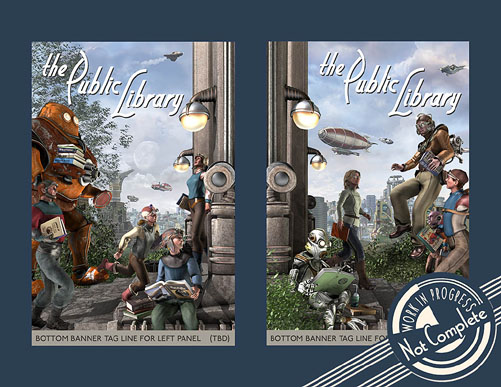
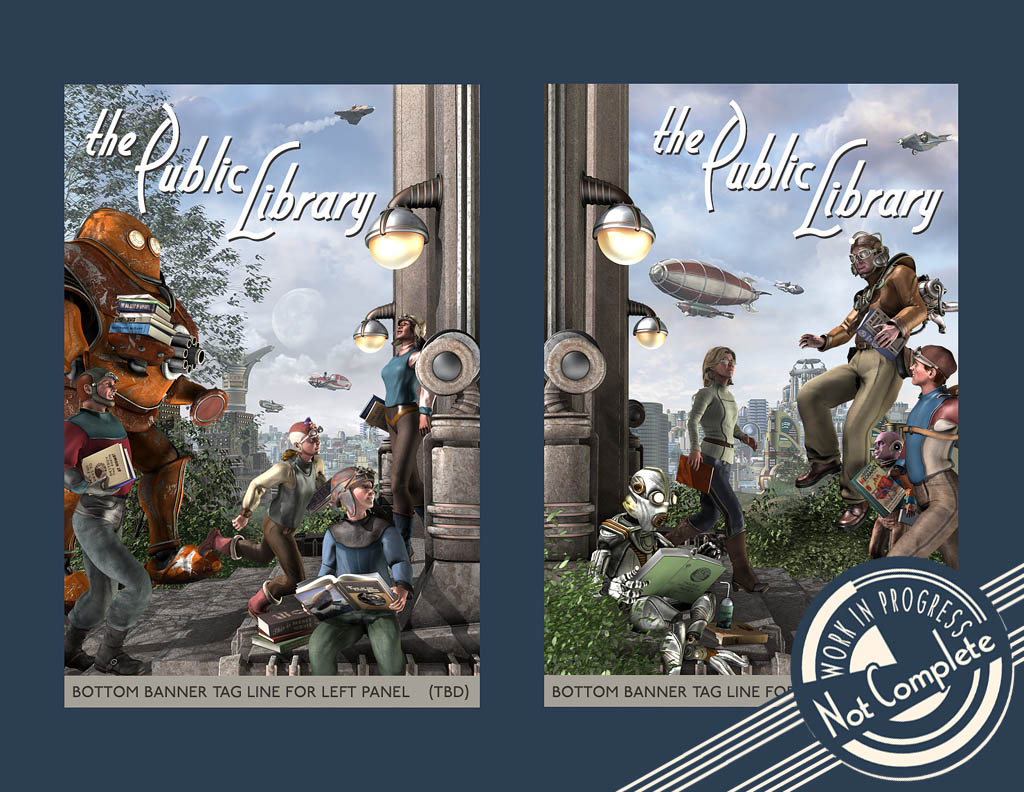
Brad Schenck is an old friend of mine, and a great artist. He and I are both lovers of literature, and of places that bring literature to people, like public libraries. I spent my childhood ransacking any nearby library's collections of science fiction, fantasy, and science books. I would never have been able to read and learn so much if I'd had to track down and buy those books.
At one point, everything I had to read came from a Public Library Bookmobile that stopped in my neighborhood every week. That's how I first read George Orwell's 1984 and Animal Farm, as well as Richard Adam's Watership Down.
Even in the age of the internet, books hold a unique place. Libraries provide resources both for getting information to people, and for helping people learn what information they need to acquire knowledge they seek. And libraries mean a lot more than books these days. They are also an entrance to the information that is on the internet, helping people get information past the confusion of advertisements, unreliable web sites, and social media noise.
Brad's started an IndieGoGo campaign to produce promotional posters for public libraries--his own as well as those of contributors. And to raise funds for libraries. Plus, you can get copies of the magnificent posters for yourself.
Brad's Own Words
Have a look at what Brad says, then consider throwing in a few bucks. Or a few more.
A Larger View of the Posters
Monday, May 14, 2012
Paizo Pathfinder Lite PDFs
Paizo has regularly released inexpensive PDFs of the Pathfinder rule books as a convenient addition to their hardcopy versions. Of the various major game companies, Paizo has my favorite pricing policy on PDFs. They're cheap. Which makes it a lot easier to do what I like, which is have both the hard copy and the PDF. (Even better is the practice of some smaller publishers, like Jon Brazer Enterprises, where you get both hardcopy and PDF in one package deal!)

The PDFs for the Pathfinder books from Paizo had a problem that limited their utility, though. They have multiple layers with lots of vector art. This is great for getting the best image on any display or from any printer. It's a huge load of computation, though, if you just want to read the rule book on an e-reader or a laptop.
I originally bought the PDF of the Core Rulebook to be able to cut and paste items into my own adventures--little reminders for rules that I may not use often that would crop up, and other such things. The PDF did that job great. But when I went to put it on my Sony PRS-950 e-reader, so as to have a small, light copy of the rules where ever I went, it buried the poor e-reader's processor. Page turns took forever. It was nothing but frustration.

Even the version of the rule book that has the chapters as separate files didn't help. The files are smaller, but the computational overhead was still just too much for my e-reader. Even when I threw it on my Eee PC (a "netbook" style laptop computer), it was just too slow to use. I was reduced to extracting the text from the PDF to rather ugly text files.
Lite PDFs
Fortunately, Paizo has now released Lite PDFs of the Pathfinder books.
I downloaded them this weekend, then tried them out on my e-reader and Eee PCs this morning. What a difference! They read smoothly and well, even on the Sony PRS-950's little processor (little by current standards--it's got far more power than my primary software development workstation from the '90s!)
I'm not the only one loving these new streamlined PDFs. Have a look:
The Iron Tavern Mini Review: Pathfinder Lite PDFs
The Earthen Ring comments on Pathfinder Lite PDFs
Paizo Messageboards: PFRPG Lite PDFs


The PDFs for the Pathfinder books from Paizo had a problem that limited their utility, though. They have multiple layers with lots of vector art. This is great for getting the best image on any display or from any printer. It's a huge load of computation, though, if you just want to read the rule book on an e-reader or a laptop.
I originally bought the PDF of the Core Rulebook to be able to cut and paste items into my own adventures--little reminders for rules that I may not use often that would crop up, and other such things. The PDF did that job great. But when I went to put it on my Sony PRS-950 e-reader, so as to have a small, light copy of the rules where ever I went, it buried the poor e-reader's processor. Page turns took forever. It was nothing but frustration.

Even the version of the rule book that has the chapters as separate files didn't help. The files are smaller, but the computational overhead was still just too much for my e-reader. Even when I threw it on my Eee PC (a "netbook" style laptop computer), it was just too slow to use. I was reduced to extracting the text from the PDF to rather ugly text files.
Lite PDFs
Fortunately, Paizo has now released Lite PDFs of the Pathfinder books.
I downloaded them this weekend, then tried them out on my e-reader and Eee PCs this morning. What a difference! They read smoothly and well, even on the Sony PRS-950's little processor (little by current standards--it's got far more power than my primary software development workstation from the '90s!)
I'm not the only one loving these new streamlined PDFs. Have a look:
The Iron Tavern Mini Review: Pathfinder Lite PDFs
The Earthen Ring comments on Pathfinder Lite PDFs
Paizo Messageboards: PFRPG Lite PDFs

Labels:
Book Review,
Dungeons and Dragons,
eee,
fantasy,
gaming,
Graphics,
humor,
pathfinder,
pc,
reading,
software,
Teaching Computers
Thursday, September 9, 2010
Killing Time with Web Comics
School started this week, I've been busy with the preparations I've made for my classes as well as teaching them, on top of my regular work. I've been a bit low-key otherwise.
While I should be putting the finishing touches on my 8085 computer this afternoon, I've been reading funnies on the web instead.
The one I've been enjoying over the past few days I'm enjoying a lot. It's called Sheldon, and you'll be doing yourself a favor if you click on that link there. There are several years worth of archive up for the comic, so you can read it all from Strip One. I recommend doing it that way--it'll explain a lot that appears to make no sense otherwise.
I first learned of Sheldon through the book How to Make Webcomics. Sheldon's creator, Dave Kellett, is one of the book's authors. I got the book because I've been reading PVP for some years. and I got interested in the book. Among the things I cover in my computer classes is using the skills I teach in business, and I've incorporated some of the material in the book into my lessons.
Sheldon is cute, fun, clean (one mild swear word in almost ten years' comics I've seen so far, and some pretty abstract innuendo is the worst I've seen), and a great way to avoid doing the things I don't feel like I've got the energy for right now. Besides, the weather's turned cold and that means I can't paint the enclosure on my 8085 computer today. Maybe tomorrow, but for now, back to Sheldon. What's that duck up to now?
While I should be putting the finishing touches on my 8085 computer this afternoon, I've been reading funnies on the web instead.
The one I've been enjoying over the past few days I'm enjoying a lot. It's called Sheldon, and you'll be doing yourself a favor if you click on that link there. There are several years worth of archive up for the comic, so you can read it all from Strip One. I recommend doing it that way--it'll explain a lot that appears to make no sense otherwise.
I first learned of Sheldon through the book How to Make Webcomics. Sheldon's creator, Dave Kellett, is one of the book's authors. I got the book because I've been reading PVP for some years. and I got interested in the book. Among the things I cover in my computer classes is using the skills I teach in business, and I've incorporated some of the material in the book into my lessons.
Sheldon is cute, fun, clean (one mild swear word in almost ten years' comics I've seen so far, and some pretty abstract innuendo is the worst I've seen), and a great way to avoid doing the things I don't feel like I've got the energy for right now. Besides, the weather's turned cold and that means I can't paint the enclosure on my 8085 computer today. Maybe tomorrow, but for now, back to Sheldon. What's that duck up to now?
Labels:
Book Review,
humor,
reading,
review
Thursday, October 1, 2009
Why I Didn't Renew My Subscription
This year I've allowed the subscriptions to expire on about half the magazines I used to get. I just got yet another "last issue" begging me to re-subscribe for one of them. My reasons for dropping the mags are not economic--downturn or no, I still have as many dollars to spend on magazines as I had last year. Perhaps even more. I've got magazine dollars I'm not spending now that I'd really like to find a home for, but you, the magazine publishers and editors, aren't giving me any choices that I like.
So let me tell you why I've dropped your magazines:
Not enough content.
Yes, to save money you've cut your page counts. However, you all tell me about your fine web sites with extended coverage and deeper insights.
So, following this logic, I should be happy to go to the restaurant, find half what I expect on my plate, but be pleased that they feature a wonderful web site telling me more about what they serve? Not likely.
I subscribed to almost 30 magazines last year. I'm down to about a dozen now. I don't visit the websites for any of them on a regular basis. None of them have a web site that's worth it. Besides, I don't subscribe to a magazine to get a web site. There's more web out there than I've got time to look at, available for free. And frankly, the magazine websites suck. There isn't one that draws me back.
The websites I visit repeatedly are web sites first. There's no print edition. I don't pay them money to view the sites, since I have to pay to get access to it (my ISP bills, my computer bills, my software bills.) The magazine websites that I'm not visiting regularly are poorly organized, have balky login processes, are overrun with ad content (even in the paid section) and generally are more trouble and less readable than the web sites that are first and foremost websites. Besides, when I'm paying for a magazine I'm paying you to put something on paper and deliver it to my mailbox. I want something I can hold in my hands and read without a computer, put on a shelf, tear pages out of for my coworkers, clip ads from for my contact files, or lay in a stack folded open to an article I plan to read later.
If I wanted to pay for a web site, there are some excellent ones out there that beat the tar out of any magazine's web site I've ever seen.
So, magazine folks, when you're thinking about cutting page count to cut costs, be aware that you're reducing the value of the only part of your product for which I'll pay. I pay handsomely for those who deliver what I do want, however. I have several subscriptions that cost significantly more than the industry norm. I pay it because they give me what I want. A magazine with plenty of content on paper. I subscribe to several magazines that are delivered from overseas. I put up with the delayed delivery schedule and extra mailing costs because nobody in North America delivers what they deliver.
This year, none of the magazines I dropped got dropped because of a shift in the editorial content. That's happened in the past. One magazine that I've been reading for over thirty years is walking the edge right now--their current leadership has introduced a political slant into a magazine that has been blessedly apolitical in the past.
Another magazine to which I was a charter subscriber has been trying to sell me on their wonderful new web site with all sorts of information that they aren't giving me in print. They're on the watch list, too. I'd hate to drop them, but if they don't put it in the magazine, it means nothing to me. I hope their staff figures this out, pronto. I don't buy magazines to get teaser ads for web content. If you're telling me about all the fine stuff that's not in the magazine, you're just telling me how valueless the print magazine is, and that's the only product you have that I'll pay for.
I'll pull your advertiser's ads to save their URLs for later. I won't do the same to read your articles.
I don't want your email newsletter. I couldn't care less about your web site. If you want to sell me a magazine, you'd better make it, and it alone, a product worth my time and money. Nothing else is going to get my dollars out of my wallet and into yours.
Controlled Circulation Magazines
Those of you who send me magazines for free aren't getting off easy, either. I've dropped about half of your subscriptions as well. Some of you are sending me your magazine anyway, and I roundfile it as soon as it arrives.
Cudos to one magazine for rediscovering their purpose, however. Design News magazine was a mainstay for me through the 80's. It has been less essential to me for the past 15 years or so, however, as it seemed to forget that it was an engineering magazine. I have let my subscription lapse during that time. Lately, however, I've been impressed with a turn-around I've seen, particularly in the most recent issue I read. They seem to have found out that they can print detailed technical articles to help engineers with actual design issues. I'm very happy with what I've seen and hope to see more of it.
The magazines that are most useful get read the earliest and most, and those are the magazines where I see the ads. Those are the ads that have a chance at telling me about a product that I can use, or research and recommend to my customers. In my business, I only buy in ones and twos. My customers buy by the thousands or more when they incorporate my designs into their products.
Now back to those magazines I'm not getting. First, there's that content thing. What you print needs to be something useful to me. Not a puff piece that's about as useful as what I find in an in-flight magazine. I want specifics, I want a voice of experience. I don't care if the author is with the manufacturer, some of the best information I get comes from such sources. Naturally I expect it to come from a source within the company that won't have to ask for help with long technical terms.
The second most popular reason for me not getting a controlled circulation magazine is that you don't send it to me when I sign up for it, and supposedly been approved. There are several that I'm getting emails about telling me I should be getting the mag, that I'm someone they want to get their mag, but when I sign up nothing shows up in my mailbox. There are several I&C and engineering mags that keep marketing me but, when I fill out the form, get the happy web page telling me I now have a sub, I never see a mag. But I do get more emails telling me I ought to sign up for a subscription. Time for your left hand to meet the right, people. That's the one that's cutting your own throats, by the way.
To all magazines, I can't emphasize enough:
Content, content, content. On Paper. If it's not in the magazine it doesn't exist.
Subscription based mags: Raise your rates if you have to--give me something worth money and I will pay for it.
Controlled Circulation: If the content is there, I and others like me will be, too. We'll be selling your advertiser's products when we put them in our designs.
Need a way to save money? Slash your web staff and server budget. All you need on the web is an introduction to your magazine and a subscription form. An article index can be useful sometimes. Anything else is wasted. Put the savings toward more paper.
So let me tell you why I've dropped your magazines:
Not enough content.
Yes, to save money you've cut your page counts. However, you all tell me about your fine web sites with extended coverage and deeper insights.
So, following this logic, I should be happy to go to the restaurant, find half what I expect on my plate, but be pleased that they feature a wonderful web site telling me more about what they serve? Not likely.
I subscribed to almost 30 magazines last year. I'm down to about a dozen now. I don't visit the websites for any of them on a regular basis. None of them have a web site that's worth it. Besides, I don't subscribe to a magazine to get a web site. There's more web out there than I've got time to look at, available for free. And frankly, the magazine websites suck. There isn't one that draws me back.
The websites I visit repeatedly are web sites first. There's no print edition. I don't pay them money to view the sites, since I have to pay to get access to it (my ISP bills, my computer bills, my software bills.) The magazine websites that I'm not visiting regularly are poorly organized, have balky login processes, are overrun with ad content (even in the paid section) and generally are more trouble and less readable than the web sites that are first and foremost websites. Besides, when I'm paying for a magazine I'm paying you to put something on paper and deliver it to my mailbox. I want something I can hold in my hands and read without a computer, put on a shelf, tear pages out of for my coworkers, clip ads from for my contact files, or lay in a stack folded open to an article I plan to read later.
If I wanted to pay for a web site, there are some excellent ones out there that beat the tar out of any magazine's web site I've ever seen.
So, magazine folks, when you're thinking about cutting page count to cut costs, be aware that you're reducing the value of the only part of your product for which I'll pay. I pay handsomely for those who deliver what I do want, however. I have several subscriptions that cost significantly more than the industry norm. I pay it because they give me what I want. A magazine with plenty of content on paper. I subscribe to several magazines that are delivered from overseas. I put up with the delayed delivery schedule and extra mailing costs because nobody in North America delivers what they deliver.
This year, none of the magazines I dropped got dropped because of a shift in the editorial content. That's happened in the past. One magazine that I've been reading for over thirty years is walking the edge right now--their current leadership has introduced a political slant into a magazine that has been blessedly apolitical in the past.
Another magazine to which I was a charter subscriber has been trying to sell me on their wonderful new web site with all sorts of information that they aren't giving me in print. They're on the watch list, too. I'd hate to drop them, but if they don't put it in the magazine, it means nothing to me. I hope their staff figures this out, pronto. I don't buy magazines to get teaser ads for web content. If you're telling me about all the fine stuff that's not in the magazine, you're just telling me how valueless the print magazine is, and that's the only product you have that I'll pay for.
I'll pull your advertiser's ads to save their URLs for later. I won't do the same to read your articles.
I don't want your email newsletter. I couldn't care less about your web site. If you want to sell me a magazine, you'd better make it, and it alone, a product worth my time and money. Nothing else is going to get my dollars out of my wallet and into yours.
Controlled Circulation Magazines
Those of you who send me magazines for free aren't getting off easy, either. I've dropped about half of your subscriptions as well. Some of you are sending me your magazine anyway, and I roundfile it as soon as it arrives.
Cudos to one magazine for rediscovering their purpose, however. Design News magazine was a mainstay for me through the 80's. It has been less essential to me for the past 15 years or so, however, as it seemed to forget that it was an engineering magazine. I have let my subscription lapse during that time. Lately, however, I've been impressed with a turn-around I've seen, particularly in the most recent issue I read. They seem to have found out that they can print detailed technical articles to help engineers with actual design issues. I'm very happy with what I've seen and hope to see more of it.
The magazines that are most useful get read the earliest and most, and those are the magazines where I see the ads. Those are the ads that have a chance at telling me about a product that I can use, or research and recommend to my customers. In my business, I only buy in ones and twos. My customers buy by the thousands or more when they incorporate my designs into their products.
Now back to those magazines I'm not getting. First, there's that content thing. What you print needs to be something useful to me. Not a puff piece that's about as useful as what I find in an in-flight magazine. I want specifics, I want a voice of experience. I don't care if the author is with the manufacturer, some of the best information I get comes from such sources. Naturally I expect it to come from a source within the company that won't have to ask for help with long technical terms.
The second most popular reason for me not getting a controlled circulation magazine is that you don't send it to me when I sign up for it, and supposedly been approved. There are several that I'm getting emails about telling me I should be getting the mag, that I'm someone they want to get their mag, but when I sign up nothing shows up in my mailbox. There are several I&C and engineering mags that keep marketing me but, when I fill out the form, get the happy web page telling me I now have a sub, I never see a mag. But I do get more emails telling me I ought to sign up for a subscription. Time for your left hand to meet the right, people. That's the one that's cutting your own throats, by the way.
To all magazines, I can't emphasize enough:
Content, content, content. On Paper. If it's not in the magazine it doesn't exist.
Subscription based mags: Raise your rates if you have to--give me something worth money and I will pay for it.
Controlled Circulation: If the content is there, I and others like me will be, too. We'll be selling your advertiser's products when we put them in our designs.
Need a way to save money? Slash your web staff and server budget. All you need on the web is an introduction to your magazine and a subscription form. An article index can be useful sometimes. Anything else is wasted. Put the savings toward more paper.
Labels:
engineering,
philosophy,
reading,
review
Subscribe to:
Posts (Atom)